
If your baby takes a pacifier calmly, an intact, age-appropriate one is an optional way to soothe. Reject damaged or improvised products. Never force it, and never use it to put off a feed. If the product, your baby’s reaction or feeding worries you, stop and sort that out before trying again.
Before Choosing: Reject Unsafe Pacifiers First
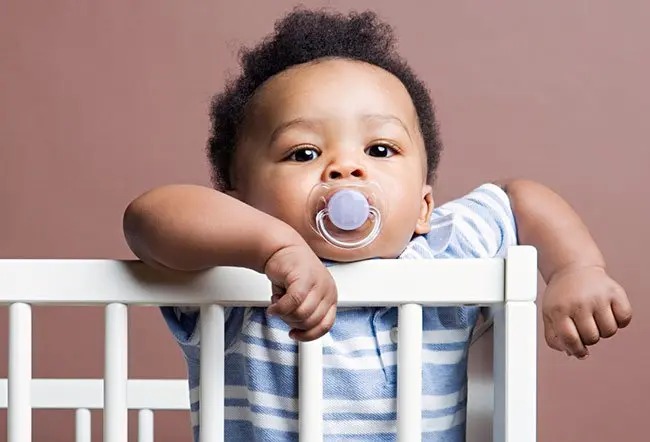
Start with a manufactured infant pacifier made for your child’s age. A bottle nipple or teething accessory does a different job, even if your baby likes sucking on it. For teething signs, gum discomfort and safe relief, see Baby Teething: Signs, Safe Relief, and When It May Be Something Else.
In the United States, pacifiers fall under 16 CFR Part 1511, explained by the Consumer Product Safety Commission. The rules cover the shield, structural integrity, warnings and attachments. The American Academy of Pediatrics (AAP) also advises a firm, ventilated shield at least 1½ inches across. That is an easy check in the store, but it doesn’t prove the whole pacifier meets the standard.
Look for the manufacturer’s name, the intended age or size, and care instructions. Inspect the nipple, shield and any accessible parts for cracks, tears or looseness. Then search the manufacturer’s name and model in the CPSC Recalls & Product Safety Warnings database.
| What you find | Decision | Why |
|---|---|---|
| Improvised bottle nipple, visible damage or the wrong age label | Reject | It fails the basic safety check. |
| Intact pacifier with a known maker, age label and care instructions | Try | Move on to fit and whether your baby accepts it. |
| No maker name, unclear label or doubtful condition | Stop and check | Settle what it is before your baby uses it. |
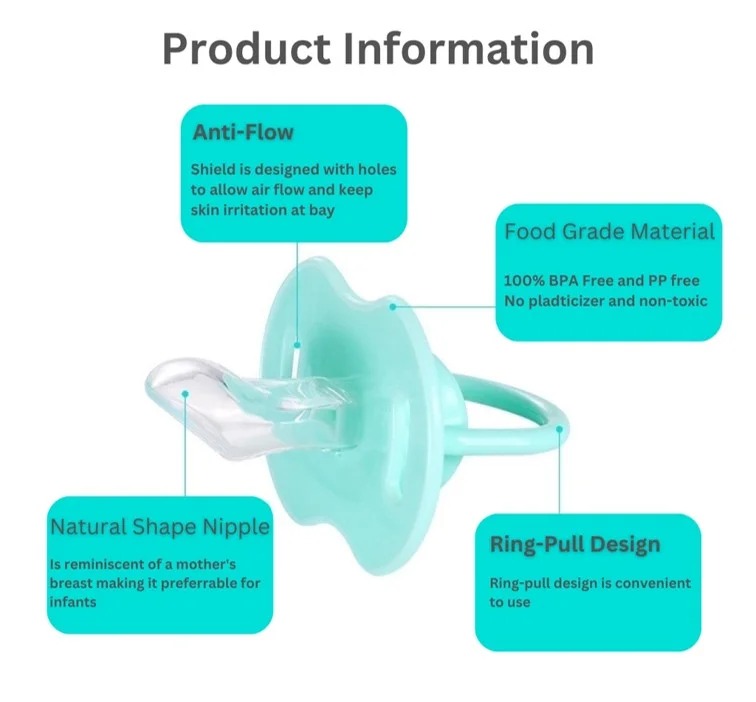
A one-piece pacifier is easier to inspect because it has fewer parts. Clips and teething clips are separate accessories with their own requirements.
For any baby younger than 12 months, never offer a pacifier containing or dipped in honey: honey can cause infant botulism.
Sizes, Shapes and Materials: What to Compare
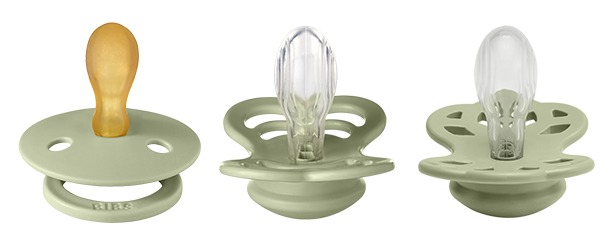
Once a pacifier passes the safety check, compare labeled size, nipple design, construction, material and the care routine you can keep up. A newborn label is only a starting point, since each manufacturer sets its own age and size ranges.
| Feature | Compare | What helps decide |
|---|---|---|
| Age and size | Manufacturer’s stated range | Whether the label fits your baby |
| Nipple shape | Round, symmetrical or orthodontic | Which one your baby takes calmly |
| Material | Silicone or natural rubber/latex | Product information, your baby’s needs and the maker’s care rules |
| Construction | One-piece or multi-part | How easy it is to inspect and clean |
| Maintenance | Washing, sanitizing and drying instructions | Whether the method fits your routine |
| Baby’s response | Calm sucking, ejecting or gagging | Whether to keep trying this design |
The word orthodontic describes the shape of the nipple. Evidence reviewed by the American Academy of Pediatric Dentistry (AAPD) doesn’t show that the shape universally prevents dental alignment problems.
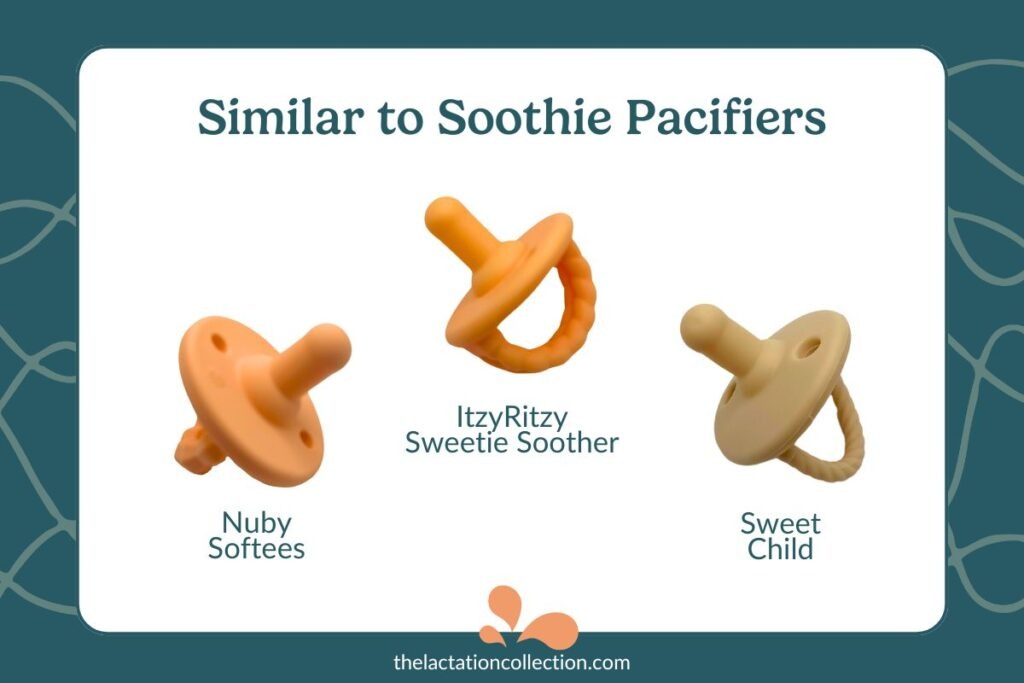
Try one suitable design first. That tells you more than buying an assortment before your baby has accepted any.
Pacifiers and Breastfeeding: Timing, Hunger and Evidence
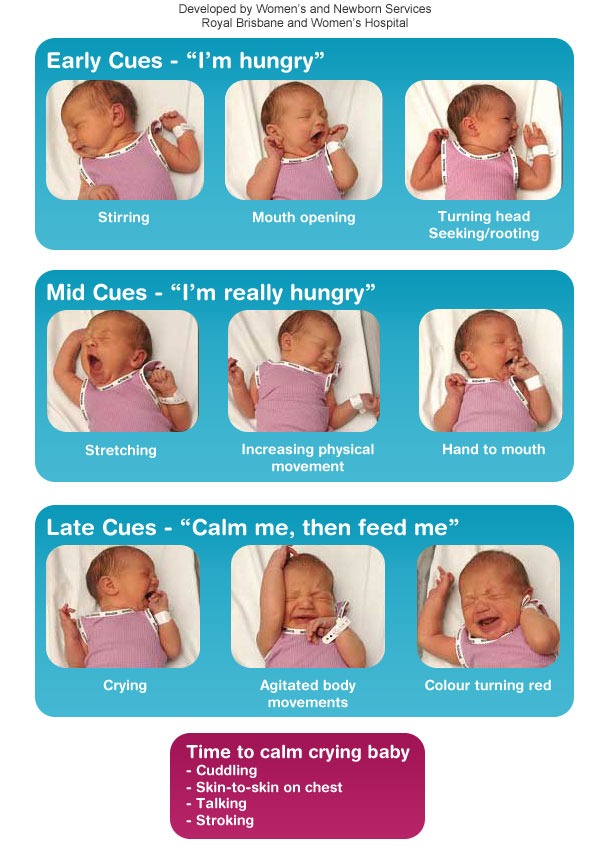
A pacifier offers sucking without milk. If your newborn is hungry or unsettled, check feeding cues and milk intake first. For crying episodes, feeding cues and caregiver support, see How to Soothe a Crying Baby (and What to Check First).
The AAP advises waiting until breastfeeding is established before you introduce a pacifier to a directly breastfed baby. It gives no set number of days. Look at how well your baby feeds and grows.
A 2016 Cochrane review analyzed two trials with 1,302 healthy, term breastfeeding infants. It found no statistically significant difference in breastfeeding through four months between the pacifier policies compared.
A 2022 systematic review and meta-analysis covered ten studies, five with term infants and five with preterm infants. Breastfeeding rates were similar in the restricted and unrestricted pacifier groups. Nine of the ten studies had some risk-of-bias concerns.
These results speak to the nipple confusion worry at group level. They can’t tell you whether your baby latches well, transfers milk or grows steadily.
One exclusively breastfeeding (EBF) parent described the problem of tending to a newborn while putting an older child to bed:
My baby is 3 weeks old and we are EBF. Ideally, I don’t want to use a pacifier. He is a really happy baby most of the time, as long as he’s held or in a carrier. My only problem is that he won’t sleep if I put him down. We have managed so far but I will be alone with him and our older son (who is 3) a lot in the near future. Especially for bedtime, I need baby to sleep on his own for at least 30 minutes while I put our older son to bed. So, I’m thinking about introducing a pacifier.
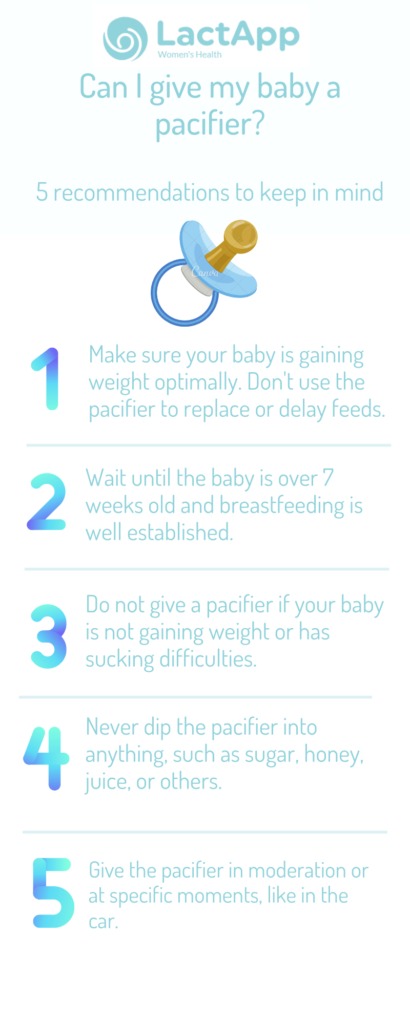
If latch, intake or growth is in doubt, ask a pediatrician or qualified lactation professional. This applies especially to a preterm, medically vulnerable or feeding-challenged baby.
When Baby Rejects a Pacifier
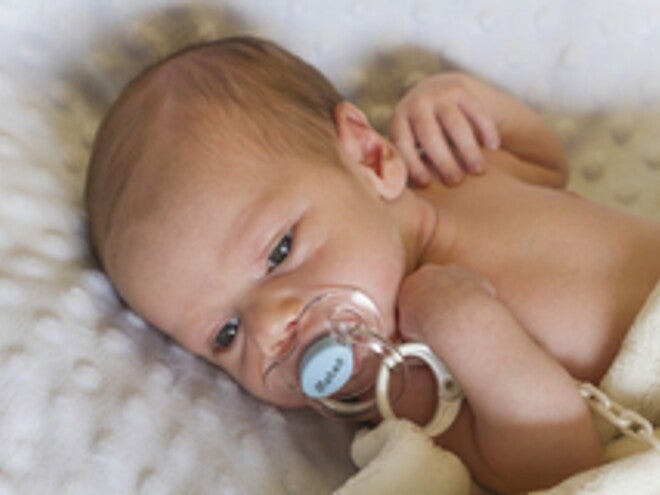
If your baby keeps pushing the pacifier out, this attempt isn’t welcome. The AAP advises against forcing a pacifier into an infant’s mouth.
One parent expected a pacifier to make sleep easier and described repeated refusal, followed by gagging when they pushed:
So I got a pacifier for my baby (1½ month old) thinking it’ll help her fall asleep faster. But, she barely keeps it in her mouth. Everytime I try, she immediately pushes it out. When I try to force her she just gags. I thought maybe she’s too young for that, but I’ve seen people on the internet using it for newborns (like for under a week babies). Am I doing it wrong somehow? I thought pacifiers would make it a lot easier to put her to sleep. But for some reason it’s not working for me.
Some babies take a different age-appropriate shape offered gently when calm. Others refuse pacifiers altogether, and holding or other soothing methods work too.
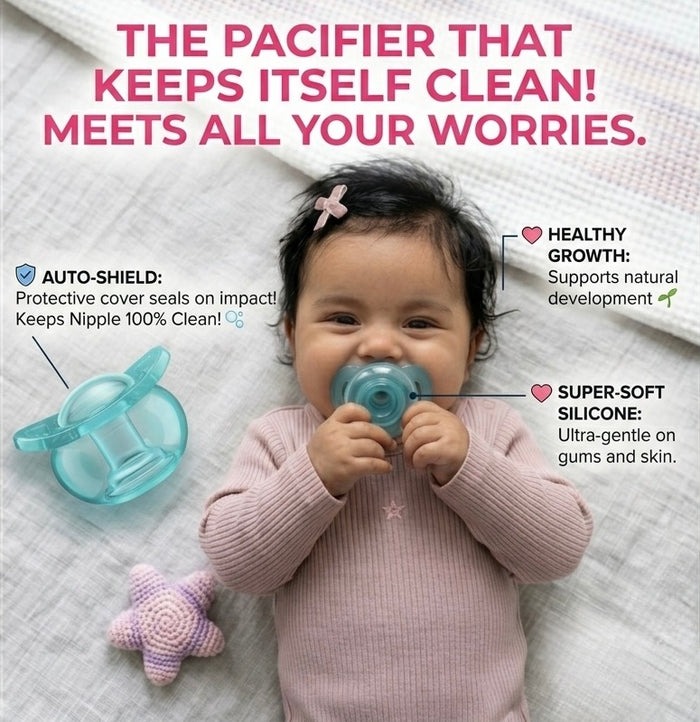
Ordinary ejection and repeated gagging are different things. Persistent gagging, or gagging along with feeding problems, calls for a conversation with your baby’s clinician.
Pacifiers at Naps and Bedtime
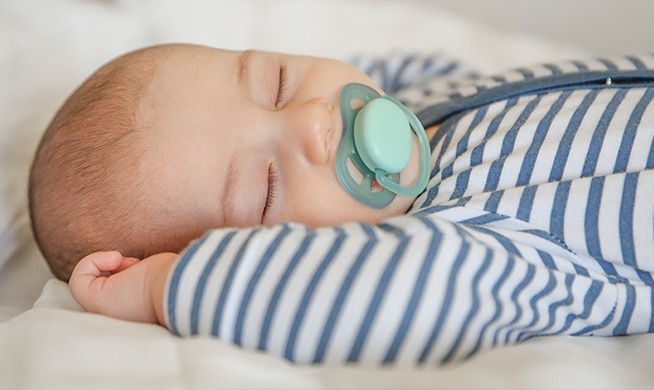
The AAP recommends offering a pacifier at naps and bedtime as one measure linked to a lower risk of sudden infant death syndrome (SIDS). The rest of the safe-sleep setup still counts, including a firm, flat sleep surface.
Offer an unattached pacifier as your baby falls asleep, if the baby accepts it. If it drops out once your baby is asleep, you don’t need to replace it.
Follow the AAP’s safe-sleep guidance for the complete setup. Keep pacifier clips, strings, clothing attachments and attached plush objects out of the baby’s sleep space.
A parent of a nine-week-old described putting the pacifier back in every few hours, then updated the post after the problem changed:
I found out that my 9 week old can sleep six hours at night without eating, but she wakes up every 2-4 hours for us to put her pacifier back in. … This is come crazy Reddit magic but the night I posted this, the issue actually resolved itself – we use the pacifier to calm her down/ transition to sleep, but she spits it out when she falls asleep and doesn’t need it for the rest of the night! She’s still not magically sleeping through the night or anything, but my pacifier anxiety is resolved.
Cleaning, Drying and Replacement
Before first use, clean and sanitize the pacifier following the manufacturer’s instructions for that model. The AAP advises cleaning often during the first six months. If a pacifier gets dirty or lands on a contaminated surface, wash it in warm or hot soapy water as the product allows, rinse well and let it dry fully.
Cleaning removes everyday soil. Sanitizing is a separate step, and methods vary. A silicone model, a natural-rubber nipple and a pacifier supplied with a microwave case each have their own requirements.
For Philips Avent pacifiers, the maker describes a five-minute boiling method. Its pacifier sterilization instructions also cover microwave carry-case procedures for some series.
| Condition | What matters | Response |
|---|---|---|
| Additional sanitizing | The method and equipment approved for that product | Use only that method |
| Water or residue trapped inside | Whether you can check and fix the inside | Stop using it if you can’t confirm it’s safe |
| Cracks, tears or weakening | A damaged nipple, shield or other part | Discard and replace it |
You can’t tell by looking whether residue is mold, minerals or something else. Don’t treat it with improvised chemicals unless the maker authorizes that method for the product.
Keep the model details after you throw out the package, so you can match the care steps to your pacifier. No replacement interval fits every design. Replace it when it is damaged or when the manufacturer says to.
When Pacifier Use Becomes a Dental or Duration Decision
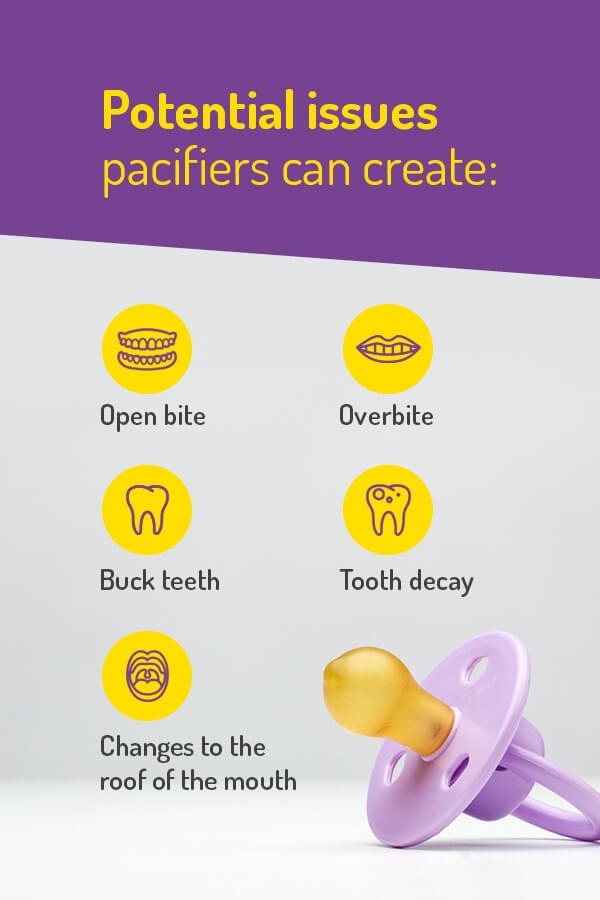
The AAPD’s 2024 policy states that pacifier use after 12 months can increase the risk of acute otitis media (middle-ear infection). Use beyond 18 months can affect developing oral structures and bite relationships. The AAPD encourages ending nonnutritive sucking habits by 36 months. It also encourages establishing a dental home by 12 months, where you can raise ongoing use or visible bite concerns.