
For most healthy babies with safe drinking water, prepare formula exactly as the label says. At room temperature, use it within 2 hours of mixing, and within 1 hour of when the baby starts drinking. A bottle you refrigerate right after mixing, before any feeding, keeps for 24 hours. Babies younger than two months, born prematurely, or with weakened immunity need extra precautions with powder. Unsafe water or a prescribed specialty formula changes the method.
Choose the right preparation method for your formula
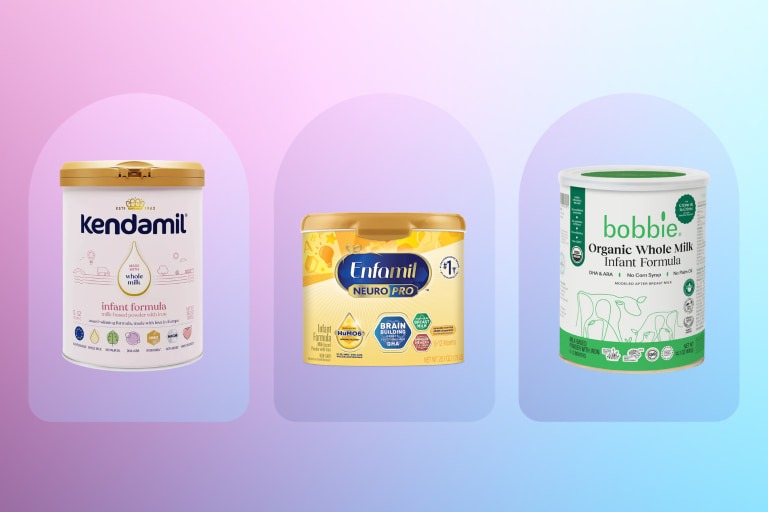
Formula comes as powder, liquid concentrate, or ready-to-feed liquid. The label tells you which one you have and how to mix it.
| Formula form | Add water? | Preparation method |
|---|---|---|
| Powder | Yes | Measure the water first, then add the exact powder amount from the label. |
| Liquid concentrate | Yes | Dilute with the amount of water on the container. |
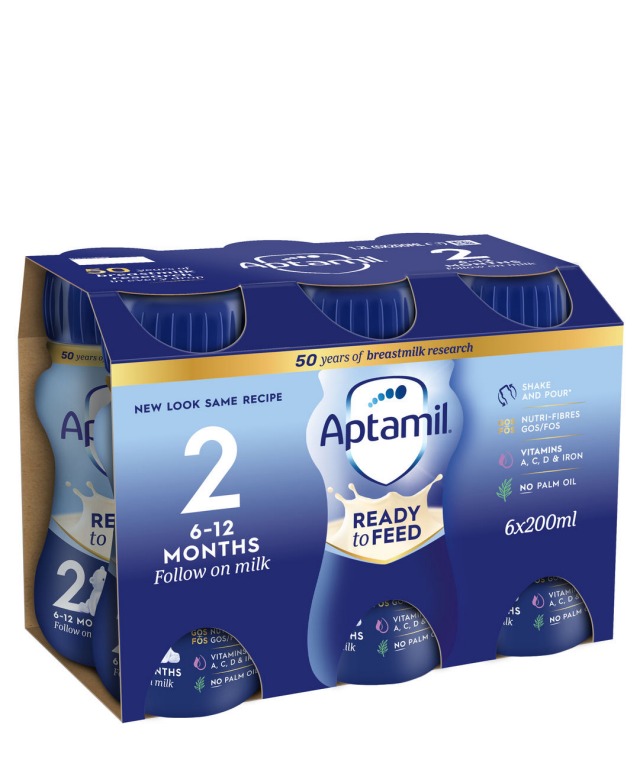
| Ready-to-feed liquid | No | Pour into a clean baby bottle. Add no water. |
A ready-to-feed carton can go straight into a bottle. A similar-looking concentrate carton needs water, and that changes how much water your baby gets. For a closer look at breast milk, infant formula, and solid foods, read Baby Feeding From Birth to 24 Months: What Changes and What to Do Next.
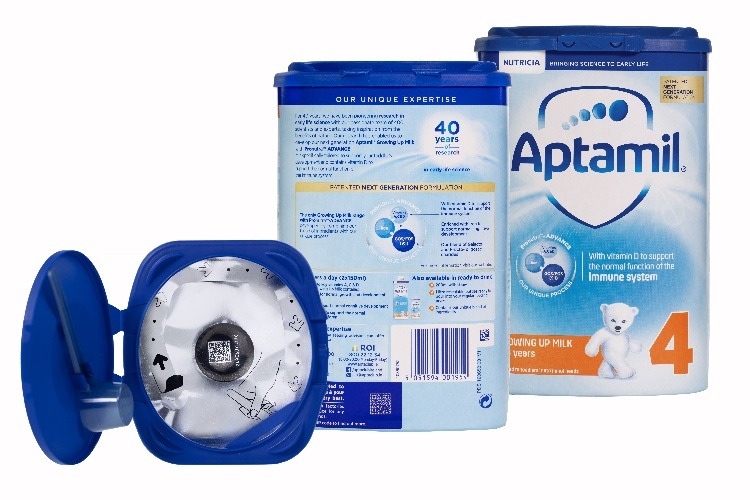
Specialized formulas for medical conditions can come with a preparation plan from your clinician. Follow it when it differs from the general instructions.
The FDA advises against homemade infant formula. Homemade recipes can lack nutrients and create serious safety problems.
When powdered formula needs extra precautions
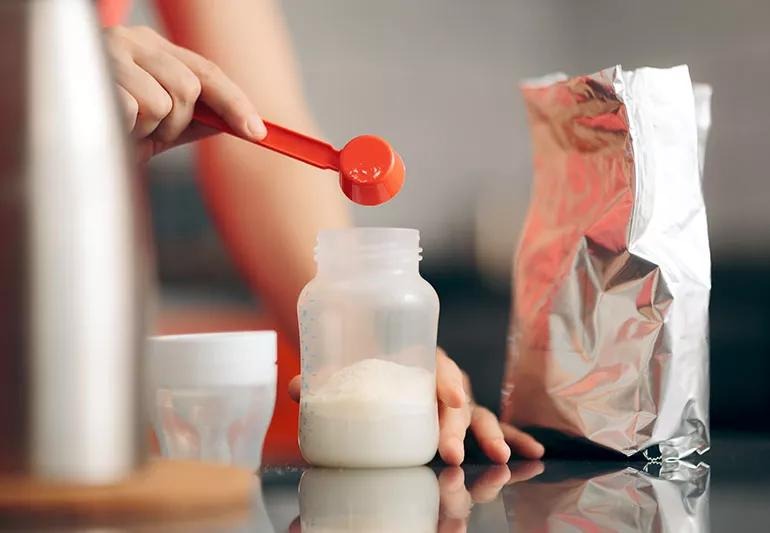
Powdered infant formula is not sterile. The CDC recommends extra precautions for babies at greater risk of serious infection from germs that can be in powder, including Cronobacter.
Use them if your baby is:
- Younger than two months.
- Born prematurely, meaning before 37 weeks of pregnancy.
- Immunocompromised. A weakened immune system calls for extra precautions even after the first two months.
Ask the care team about sterile ready-to-feed liquid formula, especially if preparing powder with very hot water is hard to do reliably.
How the CDC’s very-hot-water method works
The CDC method: boil water, let it cool for about five minutes, then add the prescribed amount of powder while the water is still very hot, around 158°F (70°C). The heat reduces germs in the powder.
- Bring water to a boil.
- Let it cool for about five minutes.
- Measure the exact water and powder amounts from the formula instructions.
- Mix as directed, then cool the formula to a safe feeding temperature.
- Check the temperature before you offer the bottle.
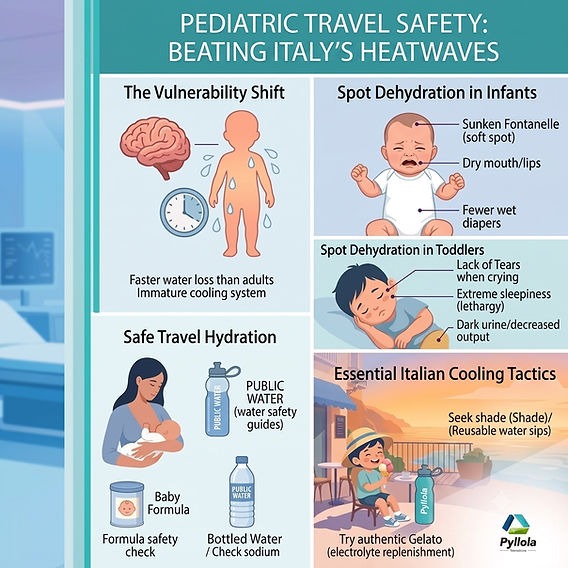
Cool the sealed bottle without letting cooling water into the bottle or nipple. Very hot formula can burn your baby’s mouth.
A six-week-old on powdered formula falls in the CDC’s higher-risk age group even if your tap water is safe. A formerly premature baby on a prescribed formula can have instructions that need a clinician’s review.
Full details: CDC’s infant formula preparation and storage guidance.
Choose water that is safe for mixing
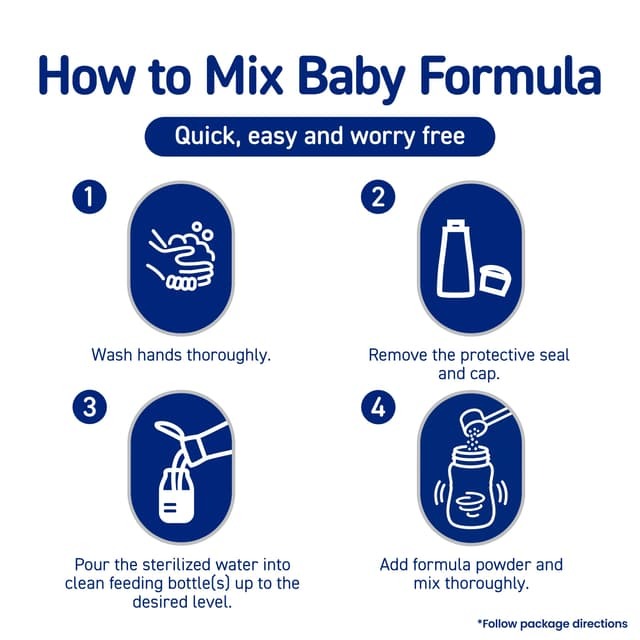
For most babies, safe tap water works for mixing formula according to the product directions. Filtered and unfiltered tap water are both fine when your water is safe to drink.
Ordinary bottled water is not necessarily sterile. A household filter does not remove every hazard.
Water safety matters most if you use a private well, are under a drinking-water advisory, or are recovering from a flood or water-main break. Your local health department or water authority can tell you the hazard and the right water source.
When boiling cannot make water safe
Boiling or disinfecting water handles certain microbes. It cannot make water contaminated with harmful chemicals or toxins safe for formula.
Water contamination and powder contamination are different problems. Water that is microbiologically safe can still require the very-hot-water method if your baby is in a higher-risk group.
In emergencies that disrupt safe formula preparation, the CDC names ready-to-feed formula as the safest option because it needs no mixing water. Follow your local public-health instructions, especially if chemical contamination is suspected.
Under a chemical-contamination advisory you need another water source, even if you normally boil water for formula.
Measure formula accurately: water first, then powder
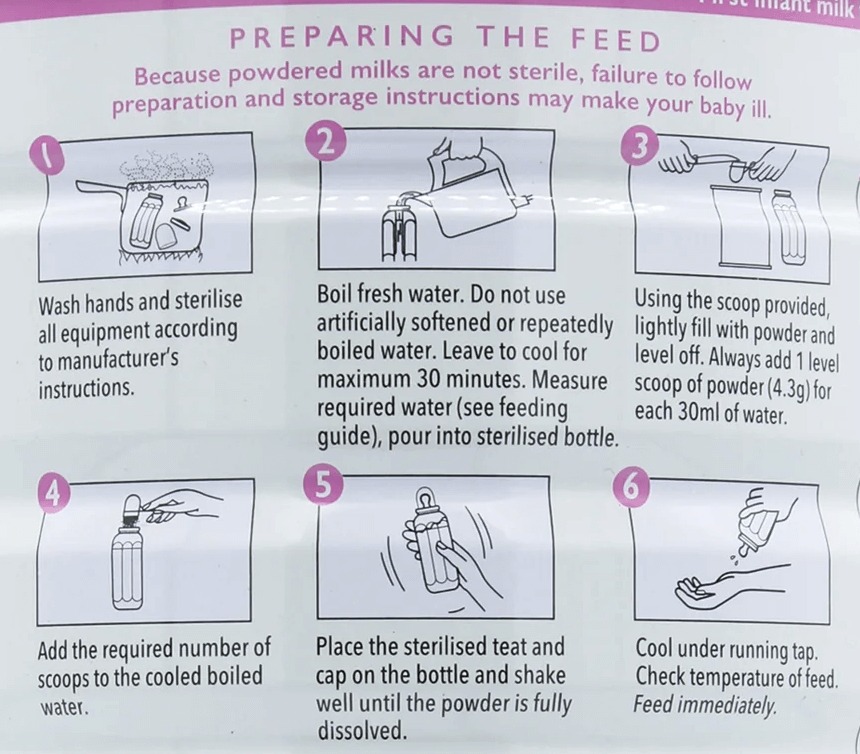
Use the exact amounts printed on the container. Each product has its own amounts, and a measuring error changes the concentration of the bottle.
Too much water dilutes the nutrition. Too little makes the feeding too concentrated and can contribute to dehydration. Do not change the concentration to make a bottle more filling or easier to digest unless a clinician tells you to.
Mixing step by step
- Prepare the work area. Wash your hands and use clean feeding equipment.
- Measure the water first. Put the exact label amount into the bottle.
- Add the powder. Use the clean, dry scoop that came with that product, filled and leveled as the label says.
- Mix as the product directs. Use the extra precautions if your baby needs them.
- Check the bottle. Both water and powder went in, and the amounts match the label.
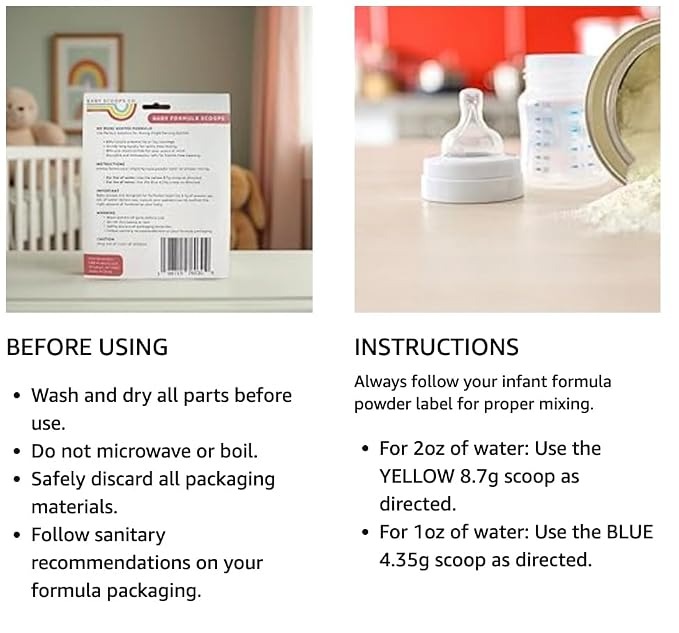
Kitchen tablespoons and scoops from other containers are not substitutes for the supplied scoop. If the powder does not dissolve as the instructions describe, check the product directions before you serve it.
What researchers observed when caregivers measured formula
In a controlled experiment, 84 caregivers prepared formula with simulated infant crying and without. Mean absolute combined measurement error was 13.9% with crying and 13.0% without. About a third of measurements were off by 10% or more: 119 of 334 (35.7%) with crying and 115 of 336 (34.2%) without. Crying made no statistically significant difference in the odds of a large error, and powder was harder to measure than water. The results come from controlled measurement tasks, not a population estimate of how often US parents prepare formula incorrectly.
The research letter appeared in JAMA Network Open on December 4, 2024. Its experimental preparation tasks included 4-ounce and 7-ounce feedings.
Clean and sanitize bottles and feeding equipment
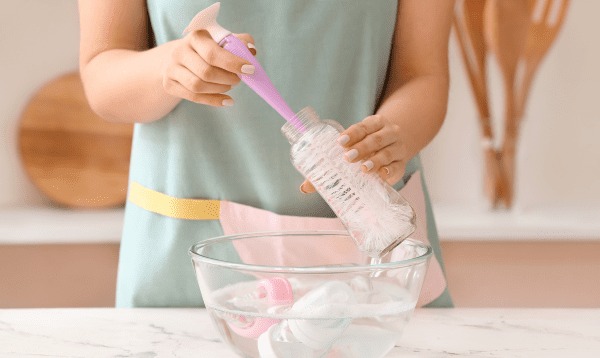
Clean baby feeding items after every feeding. Formula residue can stay in nipples, rings, valves, and other parts that are hard to inspect when the bottle is assembled.
The CDC recommends taking bottles apart before washing. Handwash in a clean basin reserved for feeding items, with a dedicated brush. Rinse, then let all parts air-dry. Don’t dry them with a kitchen towel, which can add contamination.
A dishwasher works too if the manufacturer allows it. A hot-water cycle with heated drying or a sanitizing setting can cover the sanitizing step. Check the manufacturer’s directions for heat compatibility first, and take washable parts out of pitchers and preparation machines as their instructions say.
When daily sanitizing matters
Sanitize daily if your baby is younger than two months, born prematurely, or has weakened immunity. For an older, healthy baby, careful cleaning after each feeding is enough.
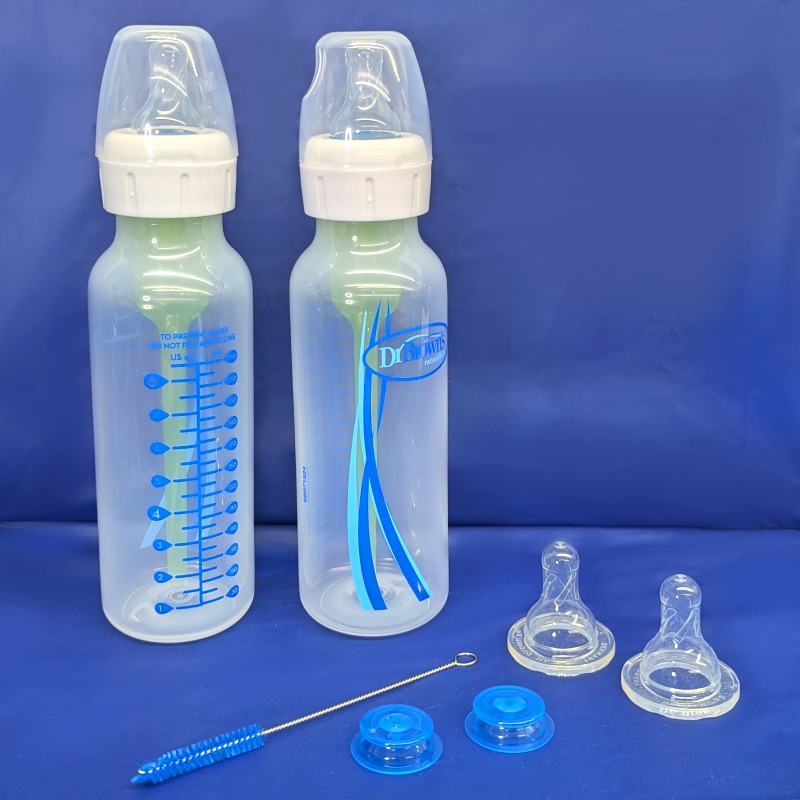
Keep powder and its scoop dry. The CDC advises against washing the scoop unless it gets soiled, and a washed scoop must be completely dry before it goes back in the container.
How long prepared formula lasts: 2 hours, 1 hour, and 24 hours
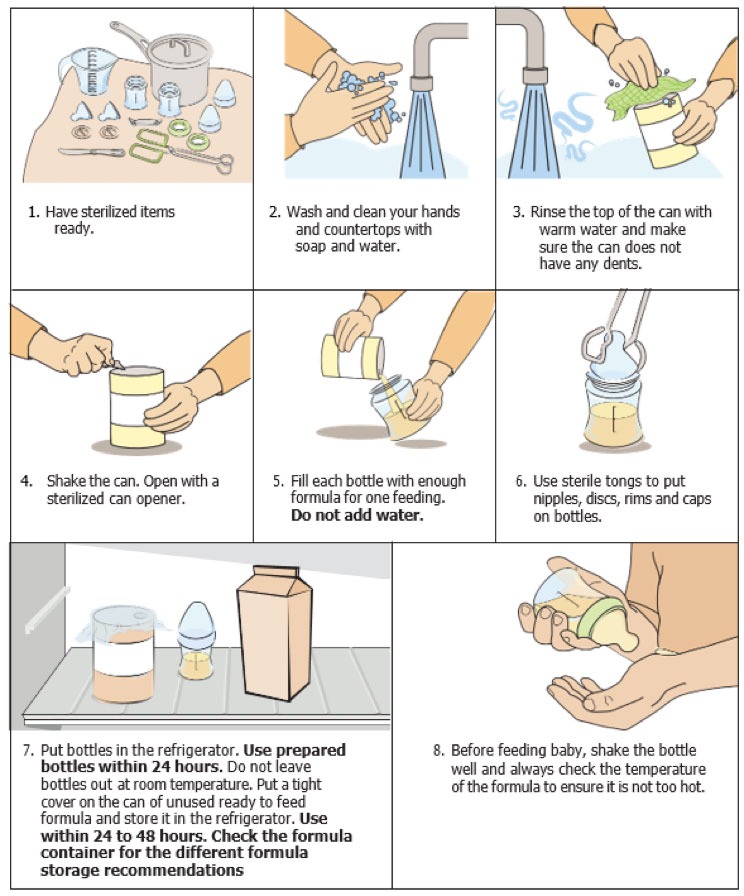
The CDC gives a separate limit for each situation.
| Formula state | Applicable limit | What to do |
|---|---|---|
| Prepared and kept at room temperature, with no feeding started | Within 2 hours of preparation | Use it or discard it. |
| Baby has begun feeding from the bottle | Within 1 hour after feeding starts | Discard what’s left. |
| Prepared, untouched, and refrigerated promptly | Within 24 hours | Keep at 40°F (4°C) or below. |
| Original ready-to-feed or liquid-concentrate container, opened, covered, and refrigerated | AAP describes up to 48 hours | Follow the original-container guidance and any shorter limit on the label. |
The 48-hour limit applies to the original container only. A prepared bottle gets 24 hours.
Once your baby drinks from a bottle, the 1-hour limit applies, and the 2-hour preparation limit still applies if it ends first. Putting the bottle down, refrigerating it after feeding starts, or offering it again later does not extend either limit.
Why leftovers from a used bottle must be discarded
Saliva can let bacteria grow in the leftover formula. Saving unfinished formula for another feeding is unsafe, even if the baby drank only a little.
Say you mixed a bottle at 10:00 a.m. and the baby started drinking at 10:30 a.m. The feeding limit ends at 11:30 a.m., before the 2-hour preparation limit at noon.
If you don’t know when a bottle was prepared, whether the baby has drunk from it, or whether it stayed refrigerated, discard it and mix a fresh one.
The American Academy of Pediatrics formula preparation guidance covers prepared bottles and opened liquid-formula containers separately.
Prepare for night feeds without leaving formula out
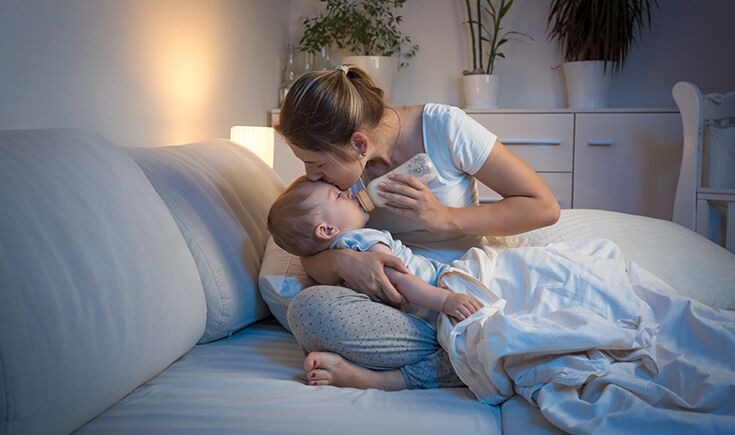
Night feeds are harder when every bottle means a trip downstairs, fresh mixing, or a long cooling wait. The storage limits stay the same as during the day.
A parent of a five-week-old on ready-to-feed formula was tired of the repeated trips to the refrigerator overnight. The plan was to pour all the night bottles at bedtime and take them upstairs:
Baby is 5 weeks old and is now consistently having formula bottles before bed/overnight as everyone sleeps much better for it. We’re using the ready-to-feed formula bottles and not powder if that makes a difference! Dad does his bedtime feed and I then do overnight feeds. We pour his bedtime bottle and take it up with us, and the leftover formula goes in the fridge. I’m then going up and down the stairs as fast as I can to get the formula while baby is kicking off, and then taking it back down before going back to sleep. Not the biggest issue in the world but definitely annoying Main question: once we’ve poured the formula into a sterile bottle, how long can that bottle sit at room temperature before baby drinks from it? He’s fairly consistently waking up around 1/2am and then again at 4/5am. Could we prep all his bottles before bed (around 9pm) and take them up with us and have them still be safe for him to drink?
A bottle left out from bedtime until a feeding several hours later is past the room-temperature limit. Keep prepared, unused bottles in the fridge until you need them.
Make night feeds easier
Keep used and unused bottles apart so you never mistake an earlier bottle for a fresh one.
The parent in the account said the baby accepted formula cold from the refrigerator.
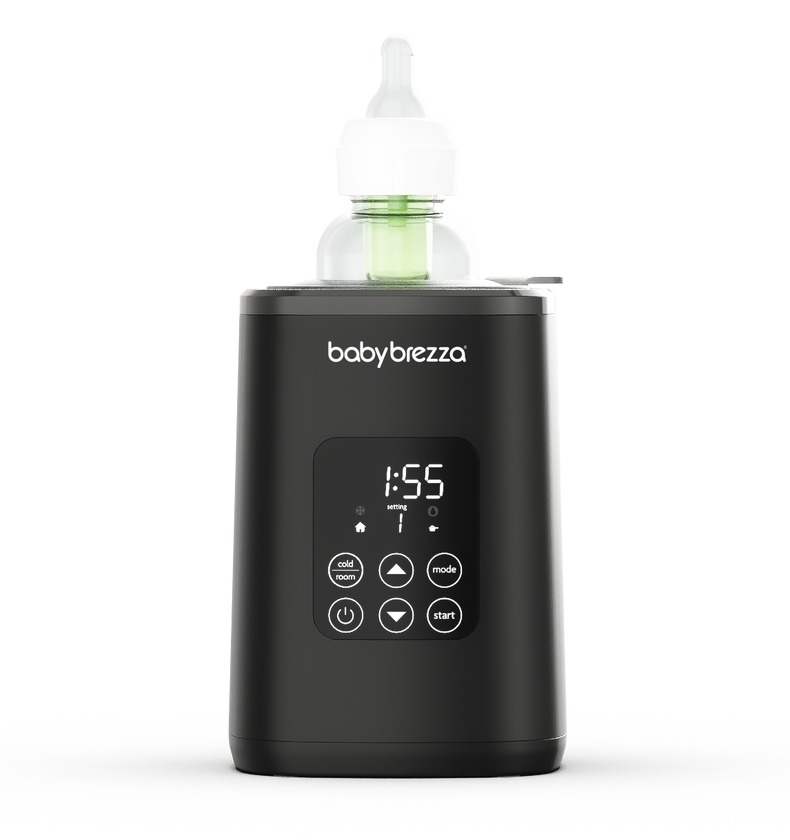
Warming is optional. If you warm a bottle, keep the warming water out of the bottle and nipple, and test a few drops on your wrist before feeding. Never microwave formula: uneven heating creates hot spots that can burn your baby’s mouth.
For babies who need the CDC’s very-hot-water method, plan time to mix with hot water and cool the bottle before the feed.
Single bottles, formula pitchers, or automatic machines?
| Method | Possible advantage | What requires attention |
|---|---|---|
| Individual bottles | Each feeding is prepared and tracked separately. | Repeated measuring, mixing, cleaning, and night preparation. |
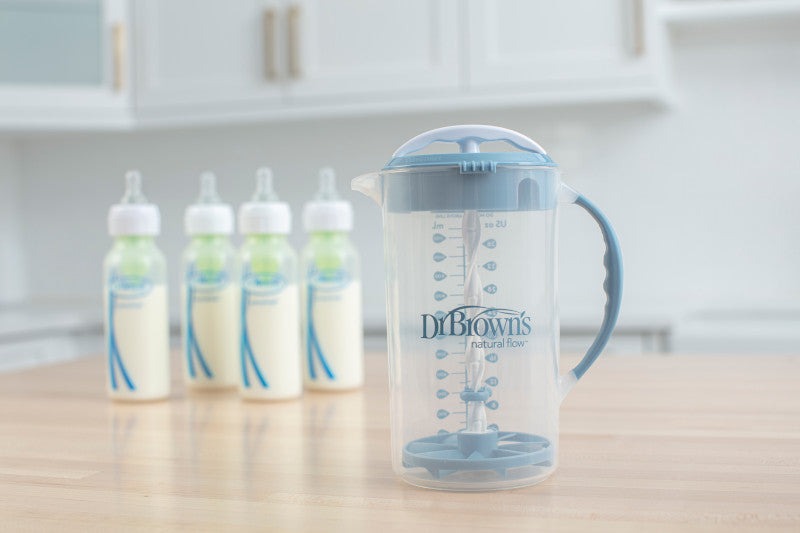
| Batch pitcher | Several portions in one session. | Accurate total mixture, clean parts, immediate refrigeration, and timing. |
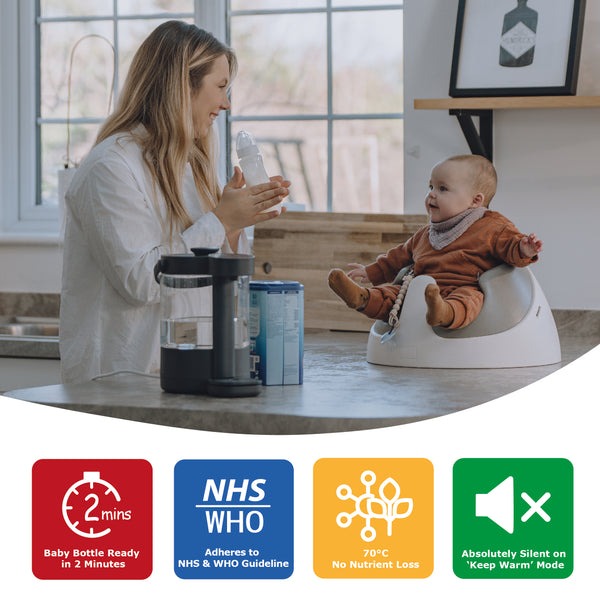
| Automatic preparation machine | Automates some preparation steps. | Formula-specific settings, measurement accuracy, cleaning, and compatibility. |
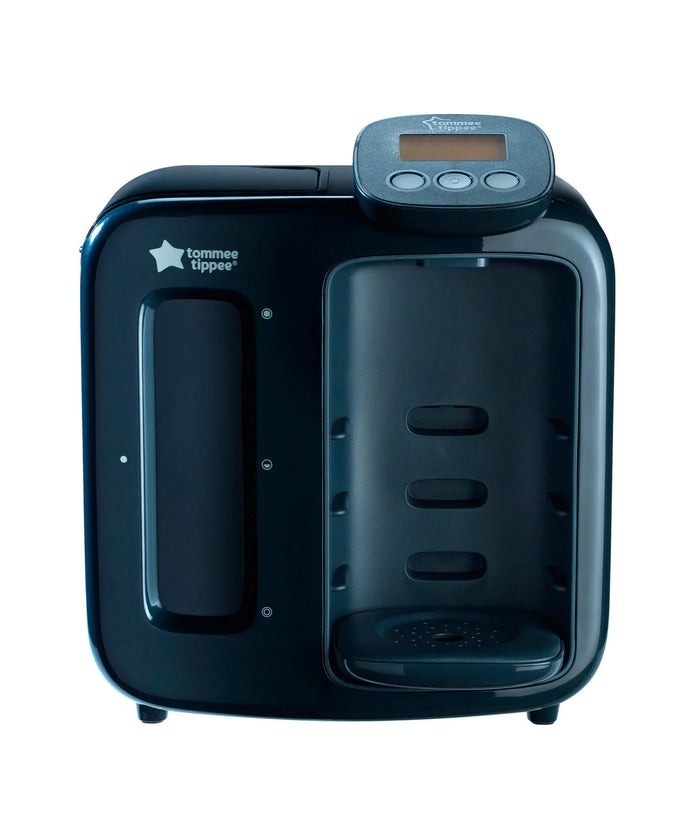
Automatic machines need settings matched to your formula and upkeep as the manual says. If a machine stores water internally, follow the manufacturer’s instructions for replacing the water and cleaning the reservoir, because warm standing water can support bacterial growth. A machine does not make powder sterile, improve digestion, or measure more accurately than careful manual preparation.
Larger batches mean more wasted formula when your baby drinks less than expected. Smaller portions waste less, if you measure each one correctly.
For bottle shape, cleaning features, and nipple flow, see the baby bottle selection guide.
What to do after a formula-mixing mistake
If your baby has not swallowed the mixture, discard the bottle and mix a new one according to the correct instructions. Don’t guess how much more powder, concentrate, or water would fix it.
If the baby has already consumed the mixture
Call your baby’s pediatric care team promptly after an incorrect mixture or an unintended water-only feeding. Age, what was swallowed, the amount, and any symptoms all matter. If the baby has a seizure, has trouble breathing, collapses, or cannot be awakened, call 911 immediately.
Keep the formula container and the intended mixing directions at hand. Tell the clinician how you prepared the bottle, how much the baby swallowed, the baby’s age, and any symptoms.
A water-only bottle discovered during a night feed
One caregiver realized during an overnight feed that the bottle held plain water, after the baby had already swallowed some:
It’s 1am, I’ve been “awake” since 12:30am, feeding my baby what I thought was formula. He starts slowing down on instake so I assume the bottle is gone. I turn on my flashlight and see he’s only taken half an ounce of WATER!! I genuinely snapped out of whatever half asleep fog I was in. Y’all please tell me he’s gonna be okay. I’ve never, in either of my other two newborn stages with my older ones, done anything like that.
For babies in the first six months, the AAP generally advises against extra plain water unless a pediatrician specifically recommends it. Don’t treat a preparation error as harmless because of the amount in someone else’s story.
Daycare, travel, and feeding handoffs
When another caregiver takes over feeding, the bottle needs a clear preparation time, a formula label, and a note on whether feeding has started. Keep prepared formula refrigerated during storage and transport. An unverified cooler or ice pack has no universal safe holding time. For feeding amounts and hunger cues, see the newborn feeding guide.
Check opened containers, expiration dates, and recalls
Store dry powder correctly
Store unopened formula as the package says, away from excessive heat, moisture, and damage. A hot car or garage is not a routine storage spot.
After opening powder, close the container tightly and keep it cool and dry. Do not refrigerate dry powder. Most opened powder should be used within about one month; the label sets the exact period.
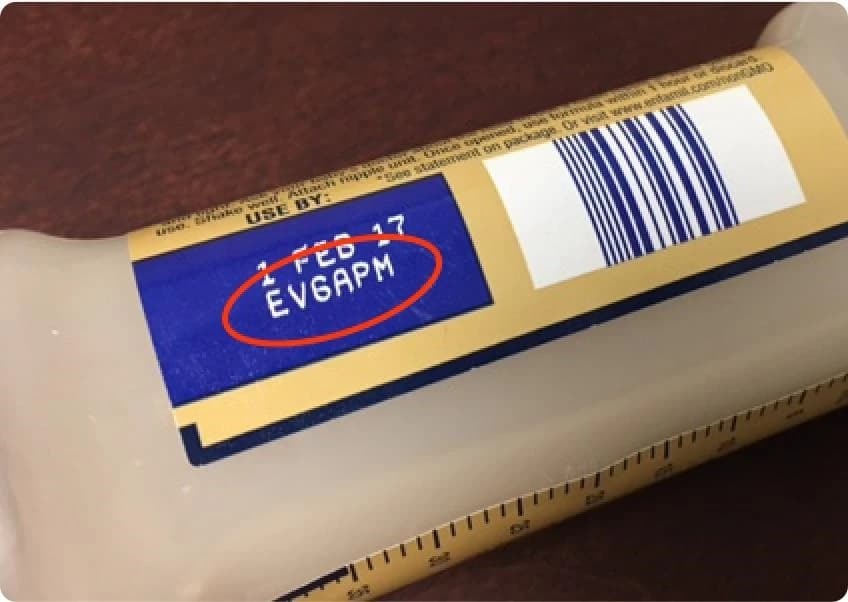
Record the opening date and check it against the container’s instructions. Never use formula past the printed Use By date. Freezing prepared infant formula is not an approved way to extend its storage life.
Check damaged products and recall notices
If a container is damaged, looks tampered with, or has an uncertain origin, don’t use it until you resolve that. Match any recall notice against the product name, formula form, lot number, and other identifying details. The FDA recalls and safety alerts database lists US notices. A headline naming a brand does not mean every container from that company is affected.